Polytheism Without Black Boxes — For a Critical Polytheism
Tradução de meu texto publicado no OZIGURATE

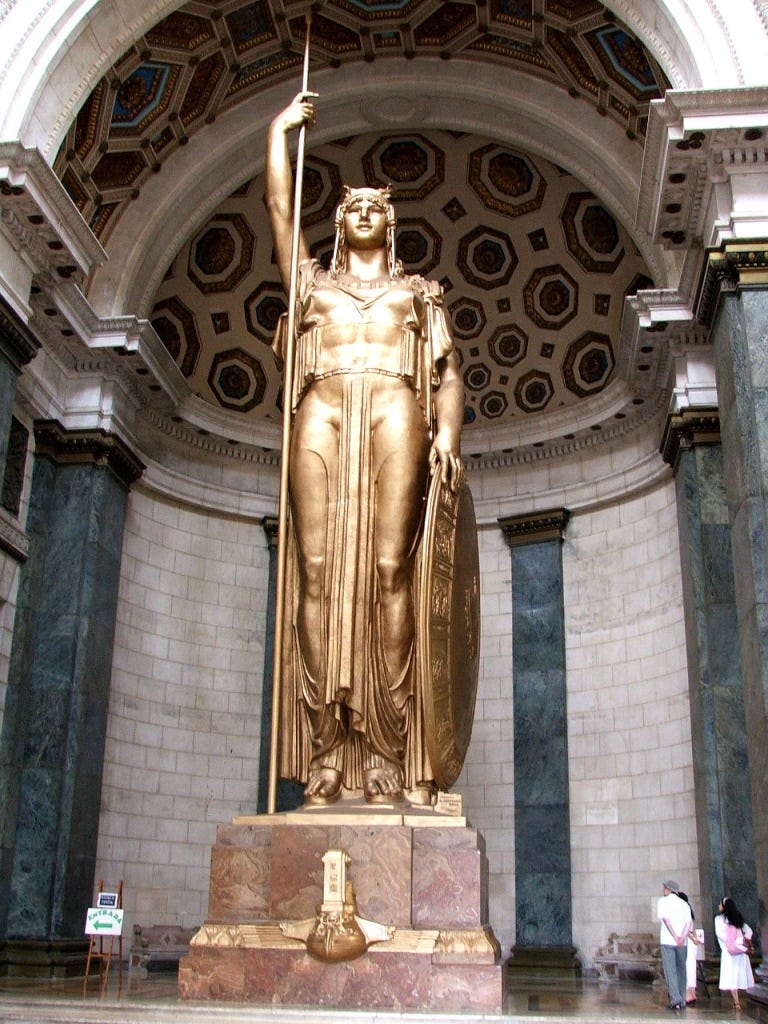
[The Statue of the Republic (1929), by Ángelo Zanelli, representing the Greek goddess Athena, at El Capitolio, Havana]
Original text: https://ozigurate.com.br/2023/11/06/politeismo-sem-caixas-pretas-por-petter-hubner/
0. Introduction
The history of contemporary paganism in the West can be divided into two major paradigms or "programs." Overcoming these is a necessary task for the elaboration of a critical polytheist perspective.
![Der Wanderer über dem Nebelmeer, painting by Caspar David Friedrich (1818). The prototypical image to use when speaking of romanticism]
1. Romantic Paganism
I use the category "romantic paganism" to designate a continuum of neopagan movements situated in very diverse historical contexts (such as 18th-century romantic nationalism and the counterculture of the 1960s) but which possess important structural similarities in their material way of dealing with the ancient pagan legacy. This category contradicts Hanegraaff's distinction (p77, 1996), which considers that the differences in political and conjunctural tenor between pre- and post-World War II neopaganism implied a substantial change between the religious movements of these two moments. Without denying the differences, I affirm that it is possible to recognize the relevant continuity of a series of practices, approaches, theological tendencies and even a "worldview" that allows us to identify a relatively unified object.
The specific foundation of this unity rests on a broader phenomenon, the so-called "anticapitalist romanticism" typified by Lukács and developed by other authors within the Marxist tradition such as Kurz, Postone and Löwy. Romantic paganism is part of this type of reaction to industrial capitalist society, correctly diagnosing at the core of this social form the unprecedented liberation of a new degree of abstraction and fluidity that distinguished it from previous forms of sociability. But instead of identifying such characteristics "in the value dimension of social forms," as Postone (2012) tells us, it ends up projecting them into a new mythology supported by a spiritual opposition where the idealized ancient organic community (Gemeinschaft) contrasts with the modern society of atomized individuals (Gesellschaft), just as the Concrete opposes the Abstract, the Autochthonous the Nomadic, the Natural the Artificial, the Sacred the Profane, Intuition Rational Calculation, the Kingdom of Quality the Kingdom of Quantity, Ereignis to Gestell, and in some dangerous cases, the "Indo-European" to the Jew.
There are disputes within the Marxist field regarding the reactionary or "mixed" nature of this type of phenomenon. Michael Löwy goes so far as to classify four distinct tendencies of anticapitalist romanticism (backward-looking, conservative, disenchanted and revolutionary), arguing that the revolutionary romantic tendency would not necessarily be trapped in nostalgia for the lost Gemeinschaft (p16, 1990). In any case, our analysis of romantic paganism will begin with a certain range of elements transversal to these various movements, with the political element being something to be problematically unfolded from them.
1.1. In Search of the Ur-religion
The search for ancestral wisdom and its projection onto more ancient civilizations was not a Renaissance and modern novelty, but was present in antiquity from Plato's reverence for Egyptian thought, through the relationship of Neoplatonism and Chaldean thought to the Renaissance phenomenon of Renaissance "Platonic orientalism" as characterized by Hanegraaff in his work "Esotericism and the Academy" (2012). Comparative mythology is also not new; the various forms of interpretatio were common in antiquity, establishing multiple competing identity relations between various pantheons depending on the attributes of the deities that were emphasized by the comparative gesture. However, just as work and money gain a new meaning in modern society, the search for ancestral wisdom and the comparative gesture are articulated in a completely new way, and anticipating a value judgment, expanding in a new context the most problematic elements inherited from their ancient context.
The unjustified premise that the antiquity of knowledge guarantees its truth was at least backed by a really existing civilization, whose heirs still walked among the younger civilizations. The solution was to invent the homeland of this ancestral wisdom (which in many cases corresponded to their own) inhabiting a glorious remote past that precedes a forgetting of this knowledge and that today returns in renewed form to the heirs of this mythical ancestry. The comparative method ceases to be a means by which relations between Gods are established, a relative and circumstantial translation of their names, to become a means by which this past can be invented as a Gesetztsein (being-posited) that sells itself as a being-there.
The comparison between two theonyms always revealed an obvious residue, not only because of the attributes of the Gods that did not fit the specific comparative gesture, but also because of the fact that it had to deal with other series of specific comparisons for each of the Gods, which through other games of associations, establish equally plausible equivalences. The idea that the same Gods incorporate different names depending on the people who venerate them was not uncommon, but it remained as an ideal of translatability that generally manifested itself incompletely, having to accept a plurality of equivalences incapable of dissolving into a unified table of correspondences, falsifying itself as an unrealizable promise. We can say that comparison made the difference between the Gods and the connecting element between both more explicit, finding through that relative identity a connection between the divinities. This connective element, the common attribute, becomes a reductive element in romantic paganism.
The historical anxiety proper to modernity is added to the fact that Myths are not, in this new context, contemporary and neighboring realities that use comparison as a way of establishing ties, but inert objects, whose value is evaluated not only by a subject alien to these realities, but also by a metric that is externalized from a process where their own images become alien to themselves. Even if one can discursively appeal to the transtemporality of mythical discourse, it is precisely this element that is mutilated by romantic desire, alienated from its own historical conditions, and ends up operating a second process of alienation, ignoring the abyss between synchrony and diachrony that separates its gesture from that proper to the ancients. In this sense, distancing (the quality of the "alien") is not even properly the central problem, but the ignorance of this distancing that is triggered in the illusion of a radical proximity, which makes it incapable of dealing with the ocean of material contingencies that sustains access to this transtemporality.
There is no doubt that modern comparative mythology has its value, but this is located in a context where the comparative gesture produces properly relative knowledge, whose conclusions are given in a very different scope from theology. Comparative literature, religious studies and archetypal psychology can benefit from methodological reductionism in relation to the tone that defines the objects of their field, but this cannot be naively transposed to the theological field as done by romantic paganism. Resacralizing the world through the reductive use of psychic archetypes or impersonal metaphysical structures is like cooling a metal sheet through its exposure to fire. The alienation of the romantic pagan in relation to the very conditions of his position is clearly manifested in the attempt to overcome what he calls "materialism" through a structure that, in the end, reproduces in the relationship between the Gods and their properties the same logic of modern market society where "...people exist for each other only as representatives of the commodity and, consequently, as possessors of commodities." (MARX, Karl p219). It is for this reason that the victory of reductive elements over connective elements will be more explicit in those currents most blind to their modern condition and most obsessed with traditional metaphysical purity; authors like Julius Evola are incapable of recognizing how vulgarly "materialist" their observations about the "purely technical" character of rites (1995, p43) and the impersonal nature of their imaginary primordial tradition (p45) are, in addition to their judgment about the "degenerate" character of polytheistic devotion (p42).
1.2. Pseudo-History
Deprived of the scientific precision of Historiography and the poetic ambiguity of Myth, where simultaneously truths are told in the form of lies and lies in the form of truths, pseudo-history becomes the means by which many will seek to anchor the authenticity of their "Tradition." The shame of novelty becomes the engine of a pathological cycle of creation in which the properly "creative" element of a new doctrine must be covered up through the invention of its own antiquity. Such inventions generally spiritualize scientific theories of their time, such as hypothetical lost continents, anthropological theses and even racial theories.
Clearly I am not speaking of the influence or inspiration that a given reading of the natural world may have in the composition of a myth – the semantic saturation of this influence or inspiration generally makes it something else, more enduring than a statement that can simply be taken as true or false. The scientific data mystified by romantic paganism is an attempt to sustain the validity of its narratives beyond (or actually, beneath) the mythological register, making its sacred truths quickly obsolete, while their profane foundations are superseded. Theses like J.J. Bachofen's Mutterrecht, now dated, influenced the imagination of politically divergent pagan currents such as Evolians and Wiccans, each creating their own mythified version of the clash between the supposed matriarchal peoples of ancient Europe and the patriarchal "Aryans." Each one's cauldron will obviously receive different ingredients; if Evolianism in its "Synthesis of the Doctrine of Race" invokes an amalgam between the thesis of a polar Indo-European Urheimat together with an imagination of probably theosophical inspiration (complete with Lemuria and other millennial traditions invented in the 19th century), Wicca will take Margaret Murray's "witch cult" hypothesis as reference for the "ancient witch cult" created by Gerald Gardner. In both cases, despite their different ideological resonances, we have a mythomania devoid of a consistently "mythogenic" effort. The need to establish the legitimacy of their discourse in the historical terrain makes the historical condition of this discourse again invisible to itself, uniting the worst of mythopoetics with the worst of historical narrative.
From a political point of view, it is correct to say that phenomena genealogically linked to Wicca such as the "Goddess movement" were undeniably progressive at the historical moment they emerged, but the crystallizing character of their mythopoetics ends up helping to reify certain contingencies that can make their emancipatory potential outdated. The myth of primitive matriarchy and of a unitary goddess essentially linked to a very specific model of human metabolic constitution has been a considerable obstacle to the inclusion of trans people, with it unfortunately not being uncommon for some practitioners to explicitly defend the exclusion of these people (as in the case of theologian Ruth Barrett).
2. Polytheistic Reconstructionism
Like romantic paganism, polytheistic reconstructionists also seem to make authenticity, truth and antiquity coincide. However, this search for authenticity and reconnection with ancestral traditions is done in a very different way from romantic pagans, being to some extent a kind of reaction to their creative excess and their fantastical vision of the past. They will seek to rescue the religious cults and beliefs of pre-Christian cultures, generally specializing in one of them (for example, in Greek, Roman or Celtic polytheism) and conducting a careful study of ancient texts, archaeology and other sources to reconstruct the religious practices of the time.
In a general sense, polytheistic reconstructionism opened the possibility of freeing itself from a series of elements inherited from the framework of the Western esoteric tradition (both in practical and theological spheres) in favor of elements better supported in the contexts in which certain divinities were venerated in the pre-Christian world. The valorization of orthopraxy over orthodoxy also allowed greater freedom of understanding of these same practices, no longer resorting to cosmological models previously sold as "universal keys," but which had little relation to them (such as the almost omnipresent Hermetic Kabbalah in the esoteric context). It is no longer about possessing the correct "initiatic wisdom," but rather performing the "correct practice."
As in the case of romantic paganism, there are also debates within polytheistic reconstructionism about its political nature. Some reconstructionists may adopt a more conservative approach, imagining ancient religion as a model for a traditional and hierarchical society (generally in a completely anachronistic and desituated way), while others may adopt a more progressive approach, adapting ancient traditions to contemporary values. In any case, the desire for authenticity of polytheistic reconstructionism will create another order of problems, which can often make it collapse into the vices it seeks to avoid.
2.1. A Pagan Protestantism
A notable advance of reconstructionism is the establishment of a religious epistemology, which will classify and discern the various degrees of validity of a practice or mythical narrative. The classification criterion seems simple: something is more valid insofar as it has greater historical foundation. In this way, they will distinguish practices and narratives that are part of the general structure of religion from those that arise from the need to fill the gaps that usually exist in the historical record. All this would be really simple if all "history" had already been established once and for all.
History, as a discipline in movement, is a field in constant debate, movement and re-actualization. Reconstructing a religion from historiography made today can give us the illusion that we are really authentically revitalizing the ancient religion, but new evidence can demonstrate that that historiography was actually incorrect. Many historiographical theses were central to the emergence of romantic paganism groups, and today their beliefs sound implausible, simply because the statements that were plausible in their time were crystallized in the form of their doctrine and practice to this day.
To some extent, reconstructionism seems to be a pagan manifestation of the Protestant spirit, seeking truth through the letter of the word without the intermediation of human fantasy. Just as Protestant reformers sought a "pure" interpretation of the Christian faith through direct analysis of the Scriptures, reconstructionists seek a "pure" understanding of ancient religions through historical and archaeological research. However, there is a patent disadvantage: there is no sacred book but at most sacred academic papers, which are eventually replaced by others indefinitely. Anchoring the authenticity of a religion in a branch of secular knowledge, naturally indifferent to the properly religious element, does not seem to be a good idea.
It is not uncommon for reconstructionists to reify historical categories created for purely pragmatic purposes. Useful boundaries that divide more or less arbitrarily fractions of time and space to make the academic investigator's life easier become parameters of religious reconstruction, making certain ways of conceiving polytheistic practice emerge that paradoxically would not have historical consistency. Extreme cases can be seen in the generalized refusal of syncretism (because of the reification of ethnic and civilizational limits that we use for our academic specializations) and sometimes even the taking of a very specific and arbitrary historical interval (for example, Greece of the classical period) as a rule and canon of religious practice.
Furthermore, the excessively archaeo-centered focus of these groups can often promote insensitivity to the descendants of the peoples who provided the names of the worshipped Gods, to the point that some of them consider themselves "more Greek than the Greeks themselves."¹ The importance of a religious practice conscious of its historical continuities and discontinuities is something to be effectively sought, but anchoring the meaning of religion strictly in this terrain seems to be an inadequate path, especially when historical inspiration is understood naively as a literal reconstruction.
2.2. The Unverified Personal Gnosis of the Ancients
The necessary and honest distinction between what was possibly ancestral practice and what are modern interpretations or developments of personal revelations is something necessary. For the religious epistemology of reconstructionism, it is crucial. Without this distinction it is impossible to determine what would be valid in general (the reconstructed historical practice) from what has relatively individual validity, the so-called "Unverified Personal Gnosis" (UPG). As we can see, history not only informs practice but is also its criterion of validity and truth, insofar as the "verification" of a certain personal or community revelation necessarily depends on the fact that it has some type of historical precedent.
Obviously we had progress here in relation to the non-criterial romantic paganism – a religious epistemology can be very useful for separating the wheat from the chaff (and every person involved in religions knows there is much chaff). In any case, a religious epistemology whose criterion of validity rests on what has already been done has no possibility of dealing with what has not yet been done. If the fear of novelty manifested in romantic paganism in the form of falsification of the past, in reconstructionism it manifests in the containment of the future, preventing religion from becoming something alive and not some kind of historical recreation puzzle. Have the Gods grown tired of speaking and are they subject to fragments of what they have already said?
Furthermore, a religious epistemology of this type could also easily get things backwards. We can imagine a scenario where the only fragment that reached us from a certain religious practice was written by a very inventive and idiosyncratic subject who created a very particular interpretation of it, and today the practitioners of the reconstructed religion will take it as a rule without ever knowing that much of what was written there only existed in his individual imagination. Here it is not only the case that antiquity should not automatically be a criterion of authority, but also that it should not be the fundamental limit of religious imagination. Otherwise, the future is already past.
All the criticism made so far has granted that the distinction between praxis and doxa presupposed by reconstructionism would be functional. The focus on "orthopraxy" to the detriment of "orthodoxy" initially seems to be a good idea; it prevents doctrinal and theological coagulation by promoting a pluralism of positions that rest on common practice, but there is profound naivety in believing that the distinction between the practical domain and the discursive domain is so rigid. Every practice is underdetermined (in the late-Carnapian sense of the relationship between theoretical terms and observational terms) by a discursive context, which determines and informs its realization, so that distinct interpretations of its meaning will retroactively imply equally distinct practices, as they are animated by different understandings and purposes. The establishment of a rigid practice ("ortho"-praxis) is not only incompatible with the plurality of theologies sought, but also with the very pretension of "reconstruction": we are in a broad narrative context very different from that of the ancients.
Polytheistic reconstructionism seems to have sought in History an anchor capable of protecting it from human arbitrariness, without realizing that History is nothing more than the temporal succession of such arbitrariness. All solidity is constructed, and all construction is impregnated with human sweat and blood, even when the divine manifests through them. Perhaps it is necessary to reconstruct our theoretical assumptions before proceeding to reconstruct a religion.
3. For a Critical Polytheism
An important insight from an intellectual tradition that begins with Kant and was expressed in the figure of the thinkers of the so-called "Critical Theory," is that of the distinction between reason (Vernunft) and understanding (Verstand), that is, between an "active" and a "passive" rationality. Active rationality is "critical" because it allows questioning the conditions under which it itself performs and opens the possibility of its own reconstruction.
While romantic paganism gets lost in the mythification of an idealized past and polytheistic reconstructionism limits itself to the scope of what is historically proven, both face a common challenge: how to maintain a religion that is alive, relevant and meaningful in the contemporary world? It is necessary to build an approach capable of recognizing the importance of constant reflection on the theological, historical, social, anthropological and political conditions that shape polytheistic religion in its current context and that condition the meaning of its practice. We must have the freedom to operate creatively through these same conditions, recognizing, beyond the illusion of authenticity, the positive value of its own novelty (consciously affirmed).
It is important to emphasize that criticism of previous paradigms is not an attack on their practitioners or even an attack necessarily directed at religions that are within these paradigms. Criticism should be read as an invitation for these traditions to recognize and overcome their own limits.
What I propose here is a third paradigm or "program" for the conscious construction of a polytheistic religiosity. Every Aufheben preserves something of its predecessors within itself – in this sense perhaps we should recognize two elements from previous programs that, if freed from their native framework, could have their potential fully developed: 1) The mythopoetic creativity of romantics and their openness to stories not yet told; 2) The reconstructionist consciousness that religion is, in some sense, a constant engineering of the Sacred that consists of a permanent dialogue with the Ancients; These two elements, freed from the melancholy of "Return," can provide us with the hope that pagan thought has the right not only to a past, but also to a future.
A pluralist meta-epistemology (perhaps inspired by Lakatos's theory of Research Programs) could make us imagine a scenario where various critical polytheistic theologies form a theological ecology, where each framework openly establishes the criteria of its own "Eupraxia" and "Eudoxia," striving to articulate their theological-practical ambitions with the dynamic terrain of Becoming and dialogue with the Ancients, without falling into dogmatic spirals or old reifications. A space for experimentation, informed and responsible. What to some extent already exists, but does not yet have its own name.
(Text by Petter Hübner)
Corollary: What is Critical Polytheism?
Since my text published in Zigurate ("Polytheism Without Black Boxes"), many people have questioned me about the meaning of a critical polytheism as an alternative to both romantic neopaganism and polytheistic reconstructionism. My objective in this text is to provide this answer in the clearest and most concise way possible.
Critical polytheism is "critical" in the sense attributed by the philosophical tradition initiated in Kant, developed by Hegel and Marx, deepened by Sohn-Rethel, and which today manifests in the "transcendental engineering" of thinkers like Reza Negarestani, Alain Badiou and Jean Pierre Caron. Critique is the form of rationality that is not content with mere understanding of things, but seeks to investigate the conditions by which we understand and conceive them, enabling us (from Marx onwards) to transform them.
What does this mean, concretely, for the construction of a polytheism? First, it implies recognizing that our relationship with the Gods is mediated by "transcendental structures" that range from our organic sensory constitution to the broad historical context in which we are inserted. The notion of "situated knowledge" becomes fundamental – we recognize the Gods from our specific situation in the world.
As Negarestani argues in "Intelligence and Spirit," the limits of our human description of the world are determined by the transcendental structure of our own experience. These transcendental structures comprise all dimensions – physiological (locomotor system and neurological mechanisms), linguistic (expressive resources and internal logical structure of languages), paradigmatic (frameworks of theoretical construction in the sciences), as well as historical, economic, cultural and political – that regulate and channel our experience.
These transcendental structures do not exist in isolation, but configure a nested hierarchy of interconnected systems that simultaneously constitute, regulate and delimit experience, where each level incorporates and presupposes the previous ones, forming an integrated system of mediation.
Applying this model to critical polytheism, we understand that our relationship with the Gods is mediated by much of these structural levels (or phenomenological daimones): from our sensory capacity to apprehend the divine, through intuition and imagination that allow us to conceive and represent the divinities, to understanding that organizes religious categories and concepts, culminating in reason that establishes theological systematizations and critical reflections on our own religious experiences.
This transcendental perspective demystifies various superstitions: from the alleged infallibility of prophets who claim to receive direct and objective messages from the divinities, to visions that reify traditions as a-historical truths, or even the confusion between historiographical interpretive models and supposedly pure descriptions of the past. More than that, this approach allows us to rethink creatively – and responsibly – religion as a metastable system permanently open to the revision of its foundations and commitments.
Such positioning is a radical recognition of the "novelty" of contemporary polytheism and an invitation to its conscious reinvention. Both we and our understanding of the Gods are in a continuous process of transformation, mediated by transcendental structures that are, themselves, historically situated and mutable.
Someone might question me whether this would lead to a kind of radical relativism in the style of Chaos Magick, but something like this would only be possible if there were only one player in this game: human consciousness. Contrary to any form of subjective idealism or magical anthropocentrism, critical polytheism is polytheistic. This means that one of its fundamental assumptions is a theistic realism, with the field of transcendental becoming being nothing more than the result of the dialectic between two specific types of subjects: mortals and immortals. If truth appears as "situated," it does not do so in a vacuum, but as the fruit of a situation that emerges from human desire to know and divine generosity in making itself intelligible to the limits of this our desire.
I conceive critical polytheism not as a single form, but as a class of polytheisms. Just as there are various types of romantic neopaganism and reconstructionism, there can be multiple manifestations of critical polytheism. My "eosiac polytheism" constitutes only a specific form of this paradigm (and still a form that contains other forms). Each variant of critical polytheism can be understood as a particular articulation of these transcendental structures – a singular configuration of this nested hierarchy that constitutes a specific religious experience and understanding.
¹ APOKATANIDIS, Katerina. When Greece is not Ancient: Colonialism, Eurocentrism and Classics (link here).
Bibliography:
EVOLA, Julius. Revolt Against Modern World. Rochester, Inner Traditions, 1995. HANEGRAAFF, Wouter J. Esotericism and the academy: rejected knowledge in western culture. Cambridge, UK, Cambridge, 2012. HANEGRAAFF, Wouter J. New Age Religion and Western Culture: esotericism in the mirror of secular thought. Leiden, BRILL, 1996. LÖWY, M. Romantismo e messianismo: ensaios sobre Lukács e Benjamin. São Paulo: Perspectiva, 1990. MARX, Karl. O Capital: Crítica da Economia Política. Livro I: O processo de produção do capital. 2ª. Edição. São Paulo: Boitempo, 2011. POSTONE, Moishe. "Antissemitismo e nacional-socialismo" – Moishe Postone, in Sinal de Menos, No. 8, 2012, pp. 14-28.
Excellent piece. I agree with everything.
I'm very intrigued by eosiac polytheism and would love to learn more about it!
The metaphor of Kantian critique here is apt, especially inasmuch as there are in my view well-founded structural analogies between Kantian transcendental idealism and Proclus' system.